






[73] Acta Biomaterialia, 77, 311-321, (2018)
Substrate curvature affects the shape, orientation, and polarization of renal epithelial cells
Sun-Min Yu, Jung Min Oh, Junwon Lee, Whaseon Lee-Kwon, Woonggyu Jung, François Amblard, Steve Granick, Yoon-Kyoung Cho*
Our study suggests curvature be an important guiding principle for advanced tissue model developments, and that curved and geometrically ambiguous substrate can modulate the cellular morphology and phenotype.

[72] Small 2018, 14, 34, (2008)
Cloaked Exosomes: Biocompatible, Durable, and Degradable Encapsulation
Sumit Kumar, Issac J. Michael, Juhee Park, Steve Granick, Yoon-Kyoung Cho*
Exosomes are protected against external stress, especially UV irradiation and elevated temperature, by a protective nanolayer of ferric ion and tannic acid. On-demand chemical degradation and further surface functionalization capabilities on exosomes open up new applications beyond their native functions.

[71] RSC Advances, 8, 35, 19651-19658, (2018)
Non-lithographic nanofluidic channels with precisely controlled circular cross sections
Yang-Seok Park, Jung Min Oh and Yoon-Kyoung Cho*
we report the application of a nanofiber printed using a near-field electrospinning method as a sacrificial mold for the preparation of polydimethylsiloxane nanochannels with circular cross sections

[70] Lab Chip, 18, 9, 1320-1329, (2018)
Fully automated, on-site isolation of cfDNA from whole blood for cancer therapy monitoring
Chi-Ju Kim, Juhee Park, Vijaya Sunkara, Tae-Hyeong Kim, Yongjin Lee, Kyusang Lee, Mi-Hyun Kim and Yoon-Kyoung Cho*
Fully integrated lab-on-a-disc for cfDNA isolation allows real-time monitoring of tumor mutation status during targeted therapy.

[69] Micromachines, 9, 3, 100, (2018)
Liquid Biopsy in Lung Cancer: Clinical Applications of Circulating Biomarkers (CTCs and ctDNA)
Minji Lim+, Chi-Ju Kim+,Vijaya Sunkara , Mi-Hyun Kim and Yoon-Kyoung Cho*
In this review, we examined the clinical significance and uniqueness of CTCs and ctDNA from NSCLC patients, isolation and detection methods developed to analyze each type of circulating biomarker, and examples of clinical studies of potential applications for early diagnosis, prognosis, treatment monitoring, and prediction of resistance to therapy. We also discuss challenges that remain to be addressed before such tools are implemented for routine use in clinical settings.

[68] PNAS, 115, 1, 14-18, (2018)
Enzyme leaps fuel antichemotaxis
Ah-Young Jee, Sandipan Dutta, Yoon-Kyoung Cho, Tsvi Tlusty, and Steve Granick*
Challenging the traditional view that enzyme kinetics are only a matter of catalyzing chemical reactions, there is mounting evidence that the enzyme catalysis enhances enzyme mobility. This is significant to programming spatio-temporal patterns of molecular response to chemical stimulus, which is common to living matter as well as to significant chemical technology. This paper shows that the enhanced diffusivity of enzymes is a “run-and-tumble” process analogous to that performed by swimming microorganisms, executed in this situation by molecules that lack the decision-making machinery of microorganisms. The result is that enzymes display “antichemotaxis” when they turn over substrate; they migrate in the direction of lesser reactant concentratio

[67] Sensors and Actuators B: Chemical, 256, 310-317, (2018)
Centrifugal Microfluidic System for a Fully Automated N-fold Serial Dilution
Tae-Hyeong Kim, Chi-Ju Kim, Yubin Kim, Yoon-Kyoung Cho*
N-fold serial dilution with a choice of N = 2, 5, 10 is fully integrated and automated on a centrifugal microfluidic system. Individually addressable, reversible diaphragm valves are utilized to enable the automatic control of the fluidic transfer and metering of the liquid.

Nobel Symposium 162 - Microfluidics, Stockholm, Sweden; arXiv:1712.08369 [physics.flu-dyn]
Centrifugal Microfluidics for Biomedical Applications
Yoon-Kyoung Cho
The Nobel Foundation's Symposium programme was initiated in 1965 and since then over 160 symposia have taken place. With the Nobel symposium summarized in this proceedings volume, we had the ambition to cover the past, current and future developments of microfluidics; a highly challenging task as there are many excellent researchers in this area and only thirty slots in the program. We tried to cover the early breakthrough contributions to the field, important developments over the years and applications of microfluidics that now propagate in vastly different directions both as industrial components or processes and as tools and methods supporting fundamental research

[66] Lab Chip 17, 24, 4171 - 4185, (2017)
Cell migration in microengineered tumor environments
Eujin Um+, Jung Min Oh+, Steve Granick, and Yoon-Kyoung Cho*
This review provides an overview of recent advances in microengineered cell migration platforms in the focus of the cell migration characteristics influenced by complex tumor microenvironment.

[65] Oncogene, 36, 49, 6823-6829, (2017)
CUT-PCR: CRISPR-mediated, ultrasensitive detection of target DNA using PCR
S H Lee, J Yu, G-H Hwang, S Kim, H S Kim, S Ye, K Kim, J Park, D Y Park, Y-K Cho, J-S Kim, and S Bae*
Here, we developed a novel method, CUT (CRISPR-mediated, Ultrasensitive detection of Target DNA)-PCR, which uses CRISPR endonucleases to enrich and detect the extremely small amounts of tumor DNA fragments among the much more abundant wild-type DNA fragments by specifically eliminating the wild-type sequences.

[64] PLoS ONE, 12, 6, e0180251, (2017)
Circulating tumor cells detected by lab-on-a-disc: Role in early diagnosis of gastric cancer
Hwa Mi Kang, Gwang Ha Kim*, Hye Kyung Jeon, Dae Hwan Kim, Tae Yong Jeon, Do Youn Park, Hyunjin Jeong, Won Joo Chun, Mi-Hyun Kim, Juhee Park, Minji Lim, Tae-Hyeong Kim, Yoon-Kyung Cho
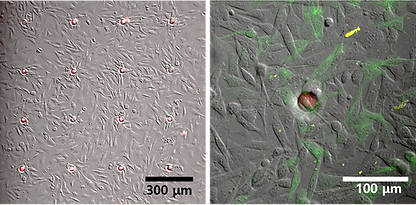
The use of circulating tumor cells (CTCs) as an early diagnostic biomarker and prognostic indicator after surgery or chemotherapy has been suggested for various cancers. This study aimed to evaluate CTCs in patients who underwent gastrectomy for gastric cancer and to explore their clinical usefulness in the early diagnosis of gastric cancer.
[63] Scientific Reports, 7, 2050, (2017)
A microfluidic chip for screening individual cancer cells via eavesdropping on autophagy-inducing crosstalk in the stroma niche
Hacer Ezgi Karakas+, Junyoung Kim+, Juhee Park, Jung Min Oh, Yongjun Choi, Devrim Gozuacik* & Yoon-Kyoung Cho*
We could demonstrate real-time monitoring of autophagy induction in fibroblasts by single tumor cells. Retrieval of individual tumor cells from the microfluidic system and their subsequent genomic analysis was possible, allowing us to determine the nature of the factor mediating tumor-stroma interactions.

[62] ACS Nano, 11, 2, 1360–1370(2017)
Exodisc for Rapid, Size-Selective, and Efficient Isolation and Analysis of Nanoscale Extracellular Vesicles from Biological Samples
Hyun-Kyung Woo, Vijaya Sunkara, Juhee Park, Tae-Hyeong Kim, Ja-Ryoung Han, Chi-Ju Kim, Hyun-Il Choi, Yoon-Keun Kim, and Yoon-Kyoung Cho*
Here, we presented a rapid, label-free, and highly sensitive method for EV isolation and quantification using a lab-ona-disc integrated with two nanofilters (Exodisc). Starting from raw biological samples, such as cell-culture supernatant (CCS) or cancer-patient urine, fully automated enrichment of EVs in the size range of 20 nm to 600 nm was achieved within 30 min using a tabletop-sized centrifugal microfluidic system.

[61] Anal. Chem., 89, 2, 1155–1162 (2017)
FAST: Size-selective, Clog-free Isolation of Rare Cancer Cells from Whole Blood at a Liquid-liquid Interface
Tae-Hyeong Kim, Minji Lim, Juhee Park, Jung Min Oh, Hyeongeun Kim, Hyunjin Jeong, Sun Ju Lee, Hee Chul Park, Sungmok Jung, Byung Chul Kim, Kyusang Lee, Mi-Hyun Kim, Do Youn Park, Gwang Ha Kim, and Yoon-Kyoung Cho*
In this work, inspired by antifouling membranes with liquid-filled pores in nature, clog-free, highly sensitive (95.9 ± 3.1% recovery rate), selective (>2.5 log depletion of white blood cells), rapid (>3 mL/min), and label-free isolation of viable CTCs from whole blood without prior sample treatment is achieved using a stand-alone lab-on-a-disc system equipped with Fluid Assisted Separation Technology (FAST).

[60] Lab Chip, 16, 19, 3741-3749(2016)
A lab-on-a-disc with reversible and thermally stable diaphragm valves
Tae-Hyeong Kim, Vijaya Sunkara, Juhee Park, Chi-Ju Kim, Hyun-Kyung Woo and Yoon-Kyoung Cho*
Here, we report on a lab-on-a-disc incorporating individually addressable diaphragm valves (ID valves) that enable the reversible and thermally stable actuation of multiple valves with unprecedented ease and robustness. These ID valves are configured from an elastic epoxy diaphragm embedded on a 3D printed push-and-twist valve, which can be easily actuated by a simple automatic driver unit.
- 1000Page 3